
If you are a school student who genuinely enjoys Physics and loves solving challenging problems, the International Physics Olympiad (IPhO) can be one of the most exciting academic journeys you can undertake.
IPhO is an international competition for secondary-school students that emphasizes deep understanding, creativity, problem-solving, and experimental skills rather than simply memorizing formulas. (ipho-new.org)
For Indian students, however, you cannot simply register directly for IPhO. There is a structured national selection process through which students compete for a place on the Indian team.
This guide explains the complete IPhO journey from NSEP to the International Physics Olympiad, along with eligibility, preparation strategy, syllabus, resources, common mistakes, and how students can start preparing.
What Is the International Physics Olympiad?

The International Physics Olympiad (IPhO) is an annual international Physics competition for secondary-school students.
The competition is conducted between individual students representing their countries. According to the official IPhO syllabus, the problems are intended to test creativity and understanding of Physics, rather than mathematical speed or memorization. (ipho-new.org)
The competition has two major components:
- Theoretical examination
- Experimental examination
This makes IPhO different from a conventional school examination. Students are expected to understand physical principles deeply and apply them to unfamiliar situations.
Who Can Participate in IPhO?
Students cannot normally apply directly to IPhO as individuals.
Each participating country selects its team through its own national selection process.
For Indian students, the Physics Olympiad pathway begins with the National Standard Examination in Physics (NSEP). The subsequent stages are conducted through the national Olympiad programme involving the Homi Bhabha Centre for Science Education (HBCSE). (IAPT)
Eligibility conditions can change from year to year, so students should always check the latest official brochure before registering.
IPhO Selection Process in India: Step-by-Step
The Indian pathway can be understood as a series of stages:
Stage 1: NSEP
National Standard Examination in Physics (NSEP) is the first stage of India’s Physics Olympiad selection process.
NSEP is conducted by the Indian Association of Physics Teachers (IAPT). IAPT describes NSE examinations as the first stage toward the international science Olympiads. (IAPT)
Students who meet the required criteria at this stage become eligible for the next stage.
Stage 2: INPhO
The next stage is the Indian National Physics Olympiad (INPhO).
This examination is conducted by HBCSE for students selected from the first stage. The level of problem-solving becomes significantly more challenging, requiring deeper conceptual understanding.
Stage 3: Orientation Cum Selection Camp
Students performing strongly at the national stage may be invited to the Orientation Cum Selection Camp (OCSC).
According to IAPT’s current Olympiad pathway information, around 40 students in Physics may qualify for the OCSC, with the final Indian team being selected based on performance during the selection process. (IAPT)
At this stage, students receive intensive theoretical and experimental training.
Stage 4: Pre-Departure Training
Students selected for the Indian team undergo further preparation before travelling to the international competition. IAPT describes this as the fourth stage of the five-stage Olympiad pathway. (IAPT)
Stage 5: International Physics Olympiad
The final selected students represent India at the International Physics Olympiad.
The Indian team competes against talented Physics students from participating countries around the world.
The Complete IPhO Journey
You can remember the pathway as:
NSEP → INPhO → OCSC → Pre-Departure Training → IPhO
This is the broad five-stage Indian Olympiad pathway described by IAPT. (IAPT)
What Does IPhO Test?
IPhO is not simply about remembering formulas.
The official IPhO syllabus emphasizes creativity and understanding of Physics. (ipho-new.org)
Students should develop strong understanding across areas such as:
Mechanics
- Kinematics
- Newton’s laws
- Momentum
- Work and energy
- Rotational motion
- Gravitation
- Oscillations
Electricity and Magnetism
- Electric fields
- Electric potential
- Current electricity
- Magnetic fields
- Electromagnetic induction
Thermodynamics
- Temperature
- Heat
- Thermodynamic processes
- Kinetic theory
Optics
- Geometrical optics
- Wave optics
- Interference
- Diffraction
Modern Physics
- Atomic physics
- Nuclear physics
- Quantum concepts
- Relativity
The exact syllabus and expected depth should always be checked against the current official IPhO syllabus.
Theoretical Examination
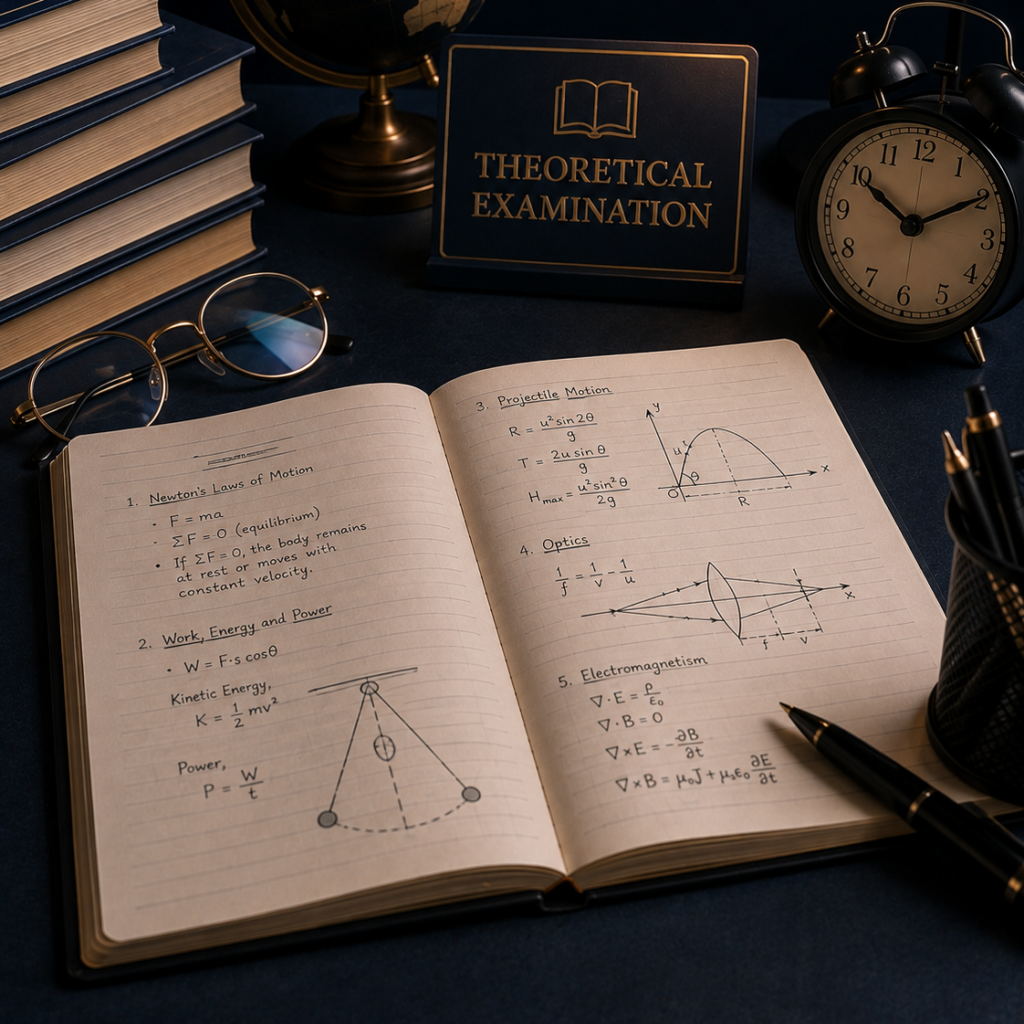
The theoretical paper is designed to test whether students can apply Physics principles to complex situations.
A problem may require you to:
- Understand the physical situation.
- Identify relevant principles.
- Make reasonable assumptions.
- Construct a mathematical model.
- Derive relationships.
- Interpret the result physically.
The goal is not simply to reach an answer.
You need to demonstrate how and why your answer follows from the Physics.
Experimental Examination
The experimental component is one of the most distinctive features of IPhO.
Students may have to perform measurements, analyze observations, process experimental data, and draw conclusions.
Important skills include:
- Measurement
- Data analysis
- Graph plotting
- Estimation
- Error and uncertainty analysis
- Experimental reasoning
Therefore, a student preparing for IPhO should not restrict preparation to theoretical problem solving.
IPhO Preparation: A Step-by-Step Strategy
Step 1: Build Strong Fundamentals
Start with school-level Physics.
Do not rush toward extremely difficult problems before understanding fundamental concepts.
Ask yourself:
What does this law mean physically?
Why does this equation work?
What assumptions are being made?
This approach develops genuine Physics intuition.
Step 2: Strengthen Mathematics
Advanced Physics requires mathematical maturity.
Develop strong skills in:
- Algebra
- Trigonometry
- Geometry
- Graphs
- Functions
- Approximation
- Basic calculus
Mathematics should become a tool for expressing Physics rather than an obstacle.
Step 3: Solve Conceptual Problems
Don’t immediately focus on the number of questions solved.
Instead, solve problems that force you to think.
After every difficult problem, ask:
What was the key idea?
Understanding the central idea behind a problem is often more valuable than memorizing its solution.
Step 4: Move to Olympiad-Level Problems
Once your fundamentals are strong, gradually introduce more challenging Physics problems.
Don’t be discouraged if you cannot solve them immediately.
Try the problem yourself, identify where you are stuck, study the solution carefully, and then attempt the problem again without looking at the solution.
Step 5: Study Previous Olympiad Problems
Previous NSEP, INPhO, and IPhO problems are extremely useful for understanding the style of questions.
Look for patterns in:
- Conceptual depth
- Mathematical modelling
- Multi-step reasoning
- Experimental thinking
The objective isn’t to memorize previous answers but to understand how Olympiad problems are constructed.
Step 6: Develop Experimental Skills
If your goal is to progress toward IPhO, don’t ignore experiments.
Practice:
- Taking careful measurements
- Recording observations
- Plotting graphs
- Estimating uncertainty
- Interpreting experimental data
Experimental Physics requires a different mindset from solving textbook numerical problems.
Step 7: Analyze Every Mistake
Keep a Physics mistake notebook.
Record:
- Concepts you misunderstood
- Mathematical mistakes
- Incorrect assumptions
- Problems you could not solve
- Better approaches discovered later
Regularly revisiting these mistakes can accelerate improvement.
How Long Does IPhO Preparation Take?
There is no fixed preparation period.
A student with strong fundamentals may progress faster, while another student may need more time.
Instead of asking:
“How many hours should I study every day?”
ask:
“How deeply am I understanding Physics?”
Consistent preparation over a long period is generally more effective than short bursts of extremely intensive study.
IPhO and JEE: Are They Related?
There is meaningful conceptual overlap, especially in Physics.
IPhO preparation can develop:
- Conceptual clarity
- Analytical thinking
- Mathematical reasoning
- Problem-solving ability
These skills can certainly help a student later prepare for JEE.
However, IPhO preparation is not a substitute for JEE preparation.
JEE has its own syllabus, examination structure, and requirements across Physics, Chemistry, and Mathematics.
Students should therefore treat Olympiad preparation as a way of developing strong Physics ability rather than as a shortcut to JEE.
Common Mistakes Students Make

1. Memorizing formulas
Understanding the physical meaning of formulas is much more important.
2. Starting with extremely difficult books
Build fundamentals first.
3. Ignoring Mathematics
Mathematical skills are essential for advanced Physics.
4. Ignoring experiments
IPhO has an experimental component, so practical skills matter.
5. Looking at solutions too quickly
Give yourself sufficient time to struggle productively with a problem.
6. Comparing yourself with other students
Olympiad preparation is a long journey. Focus on your own improvement.
7. Studying without a plan
A structured progression from fundamentals to advanced problems is much more effective.
How Igniters For Tomorrow Can Help IPhO Aspirants
Preparing for an Olympiad requires more than collecting books and solving difficult questions.
ExamsDaddy is an educational initiative of Igniters For Tomorrow, an institute focused on personalized science education and mentorship for students.
At Igniters For Tomorrow, the emphasis is on helping students understand concepts deeply and develop independent problem-solving ability.
Our approach includes:
- Personalized study planning
- Concept-based Physics teaching
- Small-batch learning
- Regular assessments
- Individual doubt solving
- Performance tracking
- A supportive learning environment
- Guidance for Olympiads and competitive examinations
For students interested in Physics Olympiads, the objective is not simply to complete a syllabus. It is to develop the ability to think, reason, model, experiment, and solve unfamiliar problems.
This foundation can also support future preparation for examinations such as JEE, IAT, and other science-focused competitive pathways.
Final Thoughts
The journey to the International Physics Olympiad is not about learning the maximum number of formulas or studying for the maximum number of hours.
It is about developing a different way of thinking.
Start with strong fundamentals. Build mathematical skills. Solve challenging problems. Learn from mistakes. Develop experimental thinking. Gradually move toward higher-level problems.
For Indian students, remember the broad pathway:
NSEP → INPhO → OCSC → Pre-Departure Training → IPhO
The exact eligibility criteria, dates, selection rules, and procedures can change from year to year, so always verify the latest information from IAPT and HBCSE before registering or planning around a particular year’s examination. (IAPT)
About ExamsDaddy
ExamsDaddy is an initiative of Igniters For Tomorrow, created to help students and parents understand competitive examinations, Olympiads, university admissions, preparation strategies, and career opportunities.
Our mission is to help students learn scientifically, prepare strategically, and make informed academic decisions.
If Physics fascinates you, don’t study it only to score marks. Learn to think like a physicist.
Leave a Reply