
The IIT JEE examination is one of the most competitive entrance examinations in India. Every year, lakhs of students prepare for JEE Main and JEE Advanced with the dream of studying at an IIT or another leading engineering institution.
Yet, many hardworking students do not achieve the result they expected.
Does this mean they were not intelligent enough?
Not necessarily.
JEE success depends on much more than intelligence. Conceptual understanding, consistency, practice, revision, time management, exam strategy, and the ability to learn from mistakes all play an important role.
Understanding the common reasons students struggle in JEE preparation can help aspirants avoid them and build a more effective preparation strategy.
1. Starting Without a Clear Strategy

One of the biggest mistakes is beginning JEE preparation without understanding what needs to be studied and how it should be studied.
Students often collect books, watch lectures, download study material, and solve random questions without having a structured plan.
A good JEE strategy should answer:
- What should I study?
- When should I study it?
- How much practice is required?
- When should I revise?
- How will I measure my progress?
A realistic study plan provides direction and prevents unnecessary effort.
2. Weak Conceptual Foundation
JEE is not primarily a test of memorization. Many questions require students to connect multiple concepts and apply them to unfamiliar situations.
If the fundamentals are weak, advanced problem-solving becomes extremely difficult.
For example, a student struggling with basic mechanics will naturally find advanced Physics problems challenging.
The solution is not simply solving more questions. Strengthen the underlying concepts first.
3. Focusing Only on Completing the Syllabus
Completing the syllabus is important—but completing it is not the same as mastering it.
Some students rush through chapters simply to tick them off their study plan. They move from one chapter to another without sufficient practice or revision.
A better approach is:
Learn → Practice → Test → Analyze → Revise
A smaller number of thoroughly mastered chapters is more valuable than superficial coverage of the entire syllabus.
4. Ignoring Revision
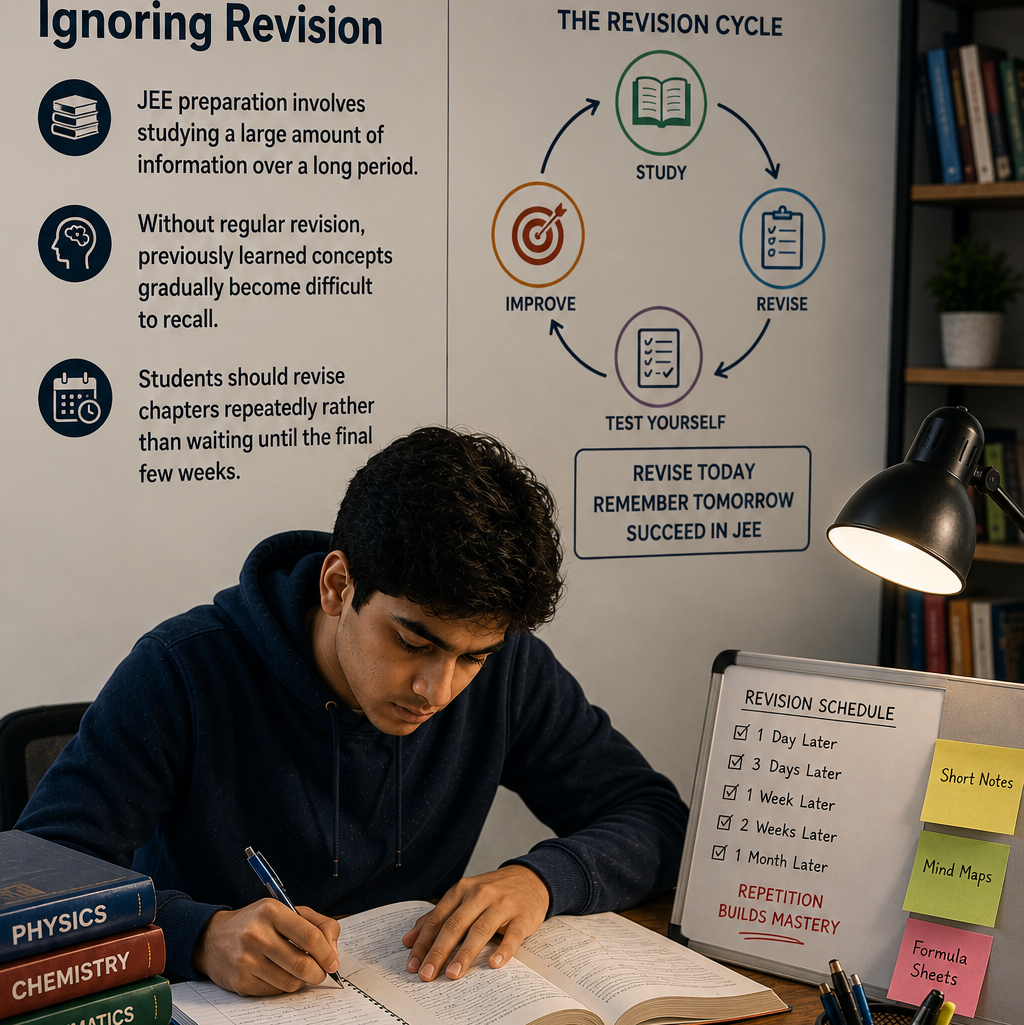
JEE preparation involves studying a large amount of information over a long period.
Without regular revision, previously learned concepts gradually become difficult to recall.
Students should revise chapters repeatedly rather than waiting until the final few weeks.
A practical revision cycle can include:
- Short revision after learning a topic
- Weekly revision
- Monthly revision
- Full-length revision before the examination
5. Solving Too Few Questions
Understanding a concept is only the beginning.
JEE requires students to apply concepts quickly and accurately. This ability develops through practice.
Students should solve different levels of problems and gradually move toward JEE Main and JEE Advanced-level questions.
However, quality matters more than simply counting the number of questions solved.
After every difficult question, ask:
Why was this approach used?
Understanding the solution is more valuable than simply knowing the answer.
6. Not Analyzing Mock Tests
Taking mock tests without analyzing them is one of the most common mistakes.
A test score tells you what happened. Test analysis tells you why it happened.
After every test, classify mistakes into categories such as:
- Conceptual mistake
- Calculation mistake
- Misreading the question
- Time-management problem
- Guessing error
- Forgotten formula or concept
This analysis provides a roadmap for improvement.
7. Constantly Changing Books and Teachers
Another common problem is resource hopping.
A student studies Physics from one teacher for two weeks, switches to another, changes books, starts a new test series, and eventually becomes confused.
There is no universally “best” book or teacher for every student.
Choose reliable resources and stay consistent with them unless there is a genuine reason to change.
8. Ignoring NCERT

NCERT should not be treated as irrelevant just because JEE is a competitive examination.
For Chemistry especially, NCERT is extremely important for building foundational knowledge and understanding many factual and conceptual areas.
Students should have a strong command of their NCERT concepts before moving extensively into advanced material.
9. Poor Time Management
JEE preparation is a long-term process. Students need to balance:
- School
- Classes or coaching
- Self-study
- Homework
- Practice
- Revision
- Mock tests
- Sleep and recreation
Studying for extremely long hours for a few days and then becoming exhausted is not an effective strategy.
Consistency beats occasional extreme effort.
10. Late Beginning of Preparation
One of the most overlooked reasons students struggle in JEE is starting preparation too late.
Many students delay serious preparation until Class 12 or even the final months before the exam, assuming they will “catch up later.” However, JEE requires time to build strong concepts, develop problem-solving skills, and gain enough practice across all topics.
A late start often leads to:
- Rushed syllabus completion
- Weak conceptual understanding
- Insufficient practice
- Lack of revision time
- High stress and pressure before exams
Starting early—ideally from Class 11 or even earlier—gives students enough time to learn concepts gradually and strengthen their foundation.
If starting late is unavoidable, the key is to prioritize:
- High-weightage topics first
- Concept clarity over speed
- Daily consistent practice
- Smart revision planning
11. Comparing Yourself With Other Students
JEE preparation can become mentally exhausting when students constantly compare their scores, study hours, ranks, or progress with their classmates.
Someone else’s preparation speed does not determine your potential.
Instead of asking:
“Why is everyone ahead of me?”
ask:
“What can I improve this week?”
Track your own progress. Improvement over time matters more than comparison.
12. Giving Up After a Few Bad Tests
A poor mock-test score does not predict your final JEE result.
Tests are supposed to reveal weaknesses.
If you score poorly, analyze the paper, identify the problems, correct them, and take another test.
The important question is not:
“What is my score today?”
It is:
“What am I doing differently after every test?”
What Does Successful JEE Preparation Actually Look Like?

Effective preparation usually combines five important elements:
Conceptual Learning + Problem Solving + Revision + Testing + Analysis
None of these can completely replace the others.
A student who understands concepts but never practices may struggle with speed. A student who solves thousands of questions without understanding concepts may struggle with unfamiliar problems.
Balance is the key.
How Igniters For Tomorrow Helps JEE Aspirants
At Igniters For Tomorrow, we believe that JEE preparation should not follow a one-size-fits-all approach.
Every student has different strengths, weaknesses, learning speeds, and academic backgrounds. Therefore, our approach focuses on personalized learning and mentorship rather than simply completing a predefined syllabus.
Through small batches, concept-based teaching, structured study plans, regular assessments, doubt-solving, and performance tracking, students receive continuous academic guidance.
The objective is to identify problems early—whether they involve conceptual gaps, inconsistent practice, poor time management, or ineffective study methods—and work on them systematically.
A supportive learning environment also helps students prepare for JEE without unnecessary academic pressure.
Final Thoughts
Not achieving the desired JEE result does not necessarily mean that a student lacks intelligence or potential. In many cases, the problem lies in the strategy, consistency, conceptual foundation, revision system, or exam approach.
The good news is that these factors can be improved.
If you are preparing for JEE, focus on understanding concepts, practice consistently, analyze your mistakes, revise regularly, and avoid comparing your journey with someone else’s.
JEE is a demanding examination—but with the right strategy, personalized guidance, consistent effort, and a scientific approach to learning, students can significantly improve their chances of success.
About ExamsDaddy
ExamsDaddy is an educational initiative of Igniters For Tomorrow, created to help students make better academic decisions through reliable exam information, preparation strategies, previous-year papers, career guidance, and educational resources.
From JEE, NEET, CUET, IAT, and Olympiads to Board examinations, our aim is to help students understand what they need to do—and more importantly, how they can do it effectively.
Leave a Reply